America’s Christian Inheritance Is Worth Defending
By Jayme Franklin

Michigan Senate Candidates Abdul El-Sayed And Mike Rogers Debate In Detroit \ Getty Images / Robin Buckson-Pool
Sponsored by Kalshi
Trade $25 with code Conservateur.
Trade responsibly.
I am a Catholic, a mother, and an American woman. I want my daughters to grow up in an America that knows what it believes.
An America where human life is sacred, marriage and family matter, faith is practiced openly, and freedom comes with responsibility. An America where we teach our children to care for their neighbors, honor their commitments, and recognize that something greater than personal happiness gives life meaning.
Those convictions begin with Christianity. Preserving them requires Christians to become more confident about explaining and living our faith in America.
We should be able to say that Christianity is true, that its teachings are good, and that we want to pass them on to our children. Respecting our neighbors does not require treating every religious belief as interchangeable.
Over the last few decades, increased immigration and the embrace of multiculturalism raise a question the West must be willing to answer: What convictions are we committed to preserving and passing on? I want America to remain confident in its Christian inheritance.
As we approach the midterms, there is a conversation Americans should be able to have honestly: How do progressive politicians reconcile their promises about women’s equality with their willingness to excuse religious authoritarianism when it comes from an ideology, Islam, they are reluctant to criticize?
We should be able to discuss Islamic customs without allowing accusations of prejudice to displace concern for the people whose freedom is at stake.
In the West, we believe in women’s freedom to speak, study, work, worship, and participate in public life without coercion.
Forced marriage, child marriage, and female genital mutilation are obscene human rights abuses. Threatening a woman for refusing religious dress or punishing someone for leaving a religion is deeply evil.
But honesty also requires precision. Islam is a religion practiced by people with different beliefs, interpretations, and political commitments. Islamism seeks to organize political life around particular interpretations of Islam. Violent jihadist movements present a distinct threat.
My Catholic faith requires me to defend religious freedom. The Church teaches that people must be free from coercion in matters of religion. That protects my right to practice Christianity and my neighbor’s right to practice another faith, or none.
A Muslim American practicing her faith freely deserves the same constitutional protections I do. However, a movement seeking to impose religious rules through government deserves scrutiny.
A September 2024 survey commissioned by the Heritage Foundation found that 39% of its Muslim respondents supported implementing Sharia in the United States within 20 years.
Religious freedom protects people’s right to believe and practice. It does not entitle anyone to control another person’s conscience.
Politicians such as Zohran Mamdani, Ilhan Omar, Rashida Tlaib, and Abdul El-Sayed should be judged by their records, proposals, and statements. Their choices of political associates also deserve examination. El-Sayed campaigned with Hasan Piker, Mamdani appeared on his livestream, and Omar joined him at a campaign rally. Piker’s record includes saying “America deserved 9/11” and “U.S. is worse than Al Qaeda.”
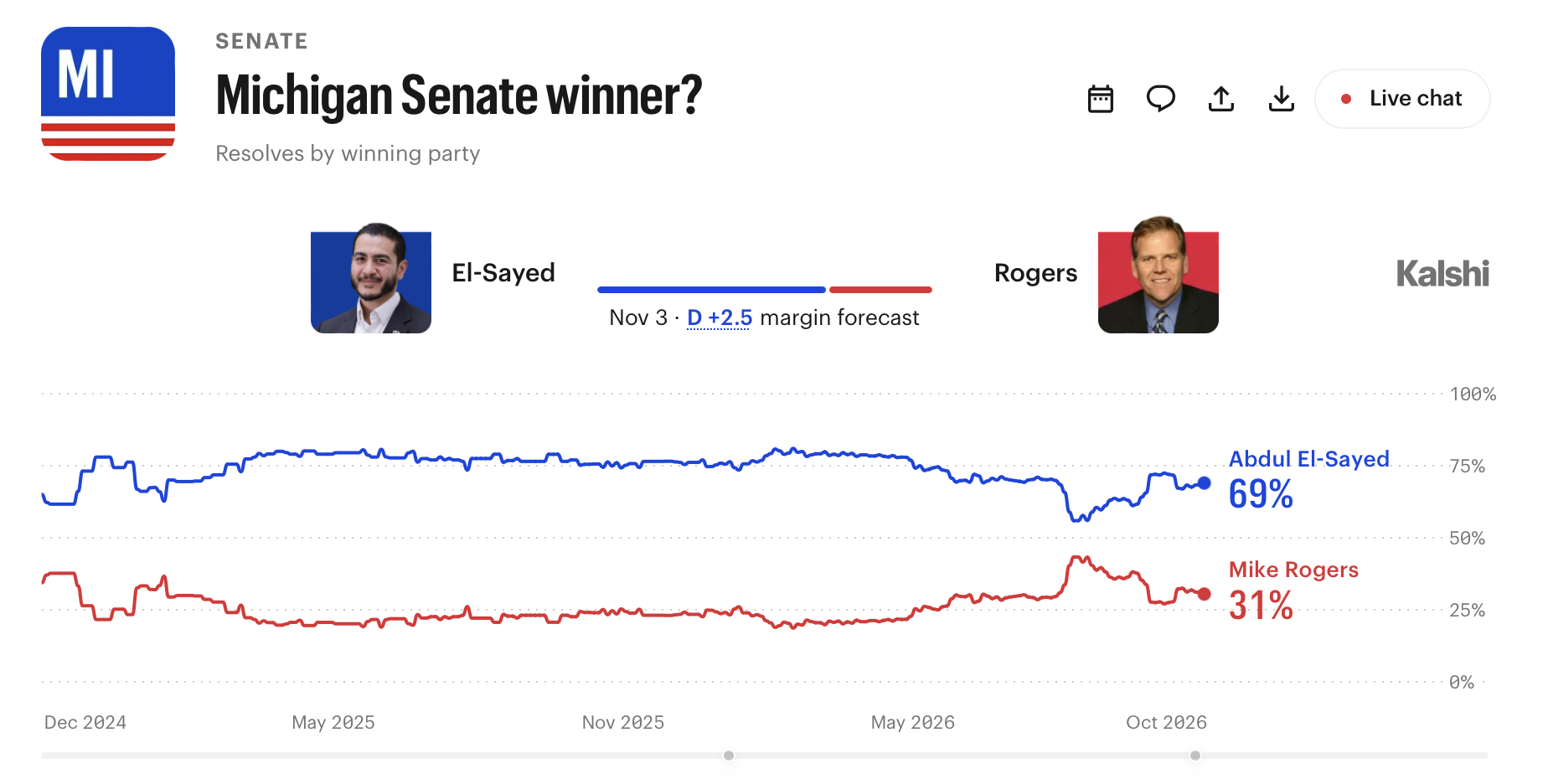
El-Sayed’s candidacy is politically consequential. Kalshi’s Michigan Senate market indicated approximately a 70% chance of his victory.
A free society must be willing to examine political and religious extremism, and their political consequences, and not take our founding, Western values for granted.
Our immigration system should reflect the same clarity. I want policies that serve Americans, uphold the law, and welcome people prepared to contribute to our country and respect its constitutional order and Christian heritage.
That means expecting newcomers to accept equal citizenship, freedom of conscience, and the rule of law. It also means welcoming their participation in a country whose Christian inheritance is worth understanding and preserving.
We can debate immigration, assimilation, taxpayer spending, and foreign aid while maintaining both national sovereignty and religious liberty.
But preserving Christian values ultimately requires something of Christians ourselves.
We believe God entered human history in Jesus Christ. We believe the Cross reveals a love that sacrifices, forgives, and calls us to conversion. That conviction shapes what I want to teach my daughters about strength, service, marriage, motherhood, and every human life.
I want them to understand why we believe these things. I want them to inherit a faith they know, practice, and can explain.
That begins in our homes and churches, through prayer, worship, faithful marriages, generosity, and care for our neighbors.
Our Christian convictions should give us the courage to discuss religious differences honestly and evaluate what cultures and customs are incompatible with our Western, Christian values.
And I want my daughters to see that defending Christianity means living it.
That inheritance is worth preserving. Passing it on will require conviction, knowledge, and the daily discipline of practicing what we profess.
After graduating from notoriously leftwing UC Berkeley in 2020, Jayme founded The Conservateur to serve and represent conservative women. Jayme’s previous work experience in the conservative movement includes the United States Senate, the Trump Campaign, the Trump White House, and Fox News. Jayme now lives with her husband, Drake Franklin, and their daughter, Vivienne, in Washington, DC.